Luis Antonio Ramírez was born in San Juan, Puerto Rico, on February 10, 1923, the youngest of five children from a middle-class family in Caguas. Although he loved music from an early age, he recalled no particular musical vocation during his childhood or adolescence, feeling instead a strong attraction to theater and, for a time, a religious calling.
After graduating from elementary school in 1937, economic circumstances led him to the José Gómez Brioso Vocational School, where he earned a diploma as an automotive mechanic. He worked in that trade for eleven years in San Juan and Caguas—years he later considered vital to his understanding of the Puerto Rican people across all social classes.
In late 1948 he left the mechanic’s shop to work first as an assistant at a San Juan radio station and soon after as Musical Advisor at the Office of Public Broadcasting, which produced programming for WIPR. When the station was transferred to the Department of Public Instruction in 1950, he was named Musical Director. It was during those years that he discovered the best of the universal repertoire and developed a marked preference for Latin-European music.
A turning point came with the arrival of Spanish maestro Alfredo Romero in Puerto Rico. Ramírez began studying music with Romero at the age of 32, and it was Romero who uncovered his hidden musical vocation and guided him toward composition studies. In 1957 he completed his high school diploma and resigned from WIPR to enroll at the Real Conservatorio de Música de Madrid, Spain, graduating in 1964.
Upon returning to Puerto Rico, Ramírez held several positions—Musical Director of WIPR Television’s educational programs, professor at the University of Puerto Rico’s Extension Division, President of the Music Section of the Ateneo Puertorriqueño—and from 1967 onward served as Professor of Harmony and Composition at the Puerto Rico Conservatory of Music. Among his many students were Roberto Sierra, Ivonne and Guillermo Figueroa Hernández, Milton Dávila, Emmy Bou, and José Daniel Martínez.
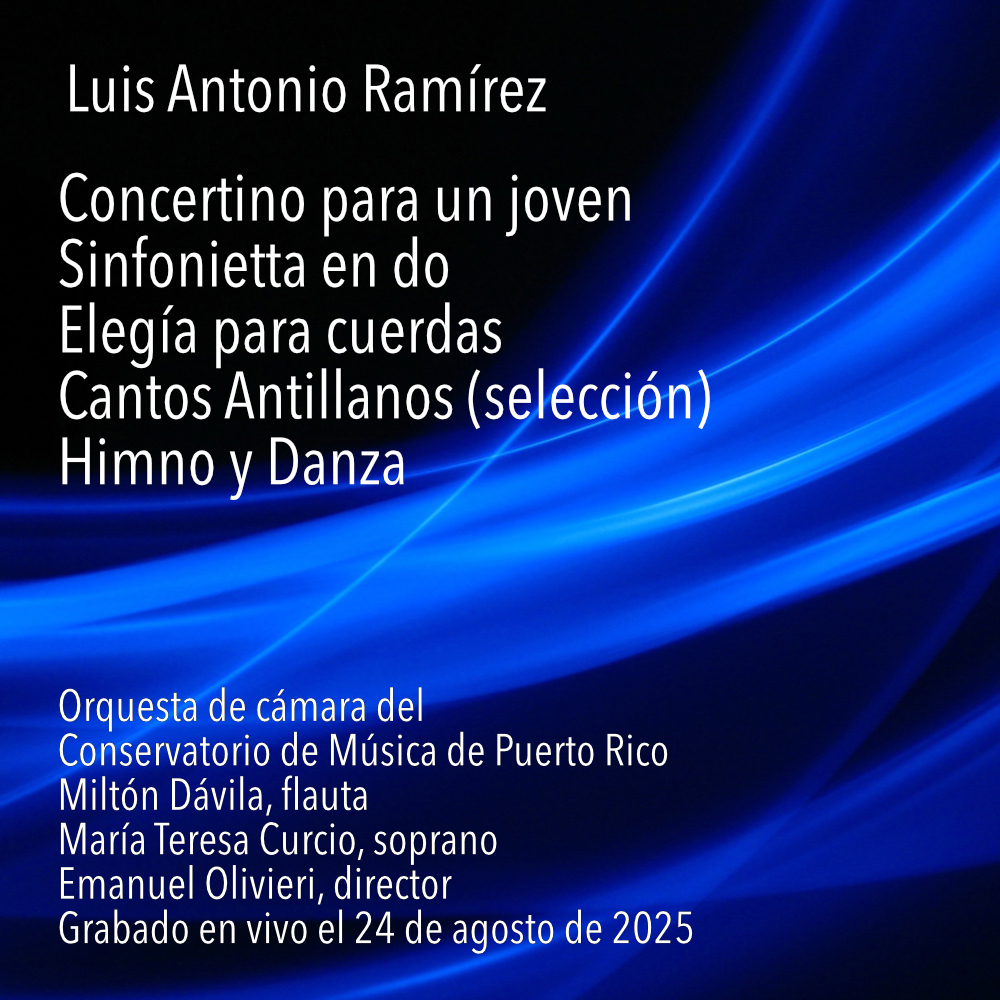
Ramírez’s catalog divides into three periods: the first (1963–1967) produced tonal, melodic, and lyrical works including the Sinfonietta en do, Nueve cantos antillanos, and Suite para pequeña orquesta; the second (1968–1972) yielded more restless and dissonant music; and the third (1973 onward) saw a fully independent voice in his symphonic poems. As he described his own music: “brief, compact, light in sonority, and clear and precise in thought.”
Chronologically associated with the generation of Amaury Veray, Héctor Campos Parsi, and Jack Delano, Ramírez nonetheless stood between generations—cultivating the growth and independence of his own personality without embracing the styles that came before or after him.
— Based on “Rasgos y Perfiles,” a lecture by Luis Antonio Ramírez at the Universidad Interamericana, San Germán, February 23, 1984.