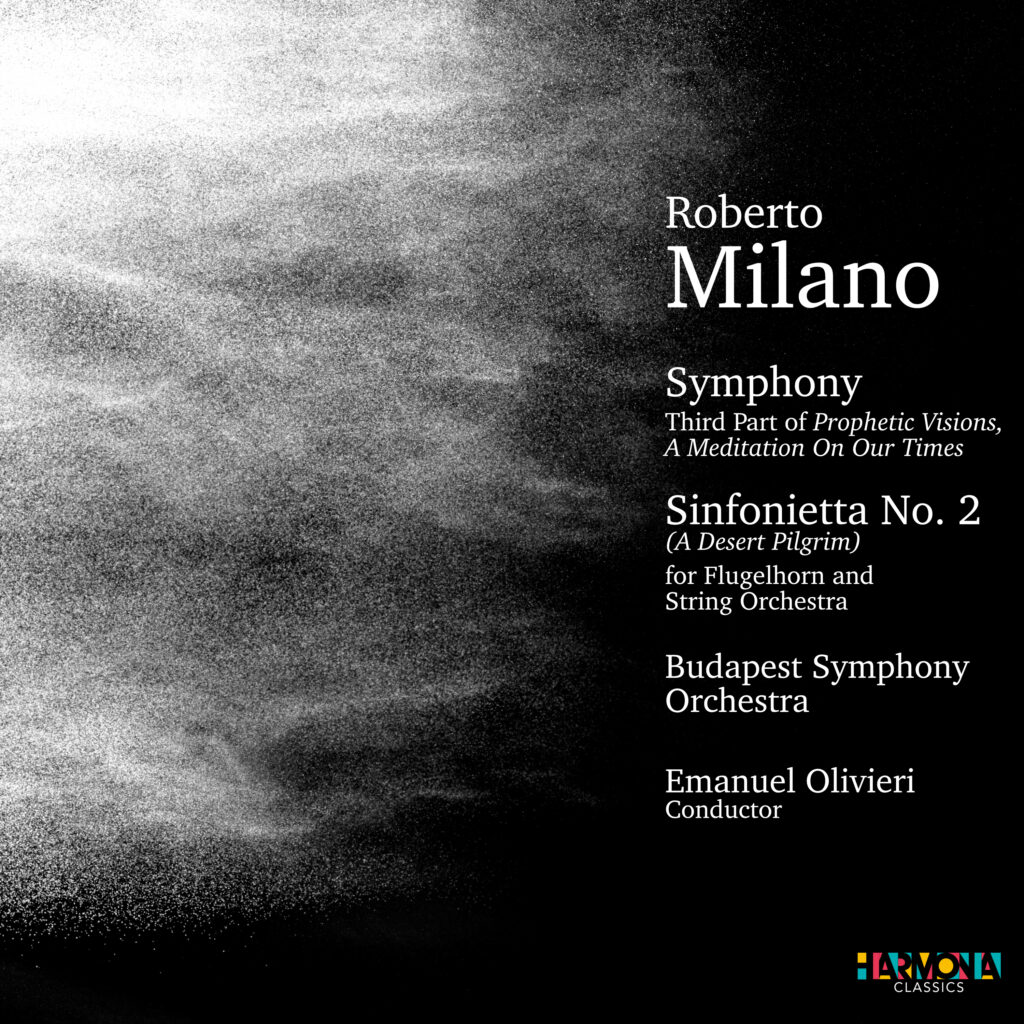
Harmonia Classics HC 0011 · 2024
Roberto Milano
Roberto Milano's last work, his Symphony in five movements, serves as the concluding piece of a triptych titled "Prophetic Visions: Meditation on Our Times." The Sinfonietta No. 2, A Desert Pilgrim, commences his final creative period.
Roberto Milano (1936-2005) was born in New York City, where he studied composition with Vittorio Giannini, Nicolas Flagello, and Ludmila Uhlela at the Manhattan School of Music. After fulfilling his military duty as a faculty member at the US Navy Music School, he continued his studies in musicology at the City University of New York and in theology at the George Mercer School of Theology. He furthered his academic training by taking pedagogy courses at Columbia University.
Milano visited Puerto Rico at the invitation of friends and later decided to settle on the island, where he served as a cultural advisor to the Municipality of San Juan and promoted the founding of the Youth Symphony Orchestra of the capital city. In 1981, he was ordained as a priest of the Puerto Rican Episcopal Church and helped found the Institute of Sacred Music to develop liturgical music in churches of all denominations.
In 1995, after teaching for a few years at the Interamerican University of Puerto Rico, he joined the faculty of the Puerto Rico Conservatory of Music, revitalizing the department of music composition. On his own initiative, he composed works for various ensembles at the institution, from elementary to advanced levels, and for members of the faculty. At the time of his sudden departure, he left more than a dozen works unperformed.
Although he did not confine himself to a particular style, preferring to adapt his techniques to the demands of each work, we can identify some stages in his career: the Hispanic exoticism of his early works written in Puerto Rico, the Hindemithean neoclassicism of the early 1990s, and the exploration of minor mode harmonies in his later works. He was never attracted to avant-garde techniques or strict atonalism. As he succinctly told a press interviewer, "My fundamental mission as a composer is that my music touches the heart of whoever listens to it, from heart to heart... and nothing more."
The Symphony, composed in 2004, is the final part of a triptych titled Prophetic Visions: Meditation on Our Times, which also includes a Concerto for Viola and String Orchestra (2001) and a Concerto for Piano and Orchestra (2002).
The concept of a trilogy traces back to an earlier work, Music for Organ and String Orchestra, composed between 1959 and 1962, and revised in 1992. Originally intended as the first part of Prophetic Visions: Meditations on the Book of the Prophet Isaiah, this music was later adapted and reorchestrated to become the second movement of the Symphony.
The first movement sets the severe tone of the Symphony, opening with a menacing tutti reminiscent of the beginning of Vaughan Williams' Sixth Symphony. The four-note motif introduced at the outset - a minor second (E-F) followed by a minor third (E-C#) - is employed throughout the Symphony in various forms. Following the introduction, the exposition begins with a fugato theme in the strings that builds intensity to a climax. A solo bassoon then begins developing the motif, which is subjected to numerous transformations by the whole orchestra. After a brief relaxation in tempo, the lower strings reintroduce the agitato mood from the beginning, leading to a reprise of the main theme that concludes the movement on a triumphant note.
The second movement is divided into three sections - Prelude, Toccata, and Elegia - as they were named in Music for Organ and String Orchestra. Like the first movement, the thematic material is largely based on minor seconds and thirds. The E-F minor second is prominently featured throughout the Prelude and violently interrupts the Toccata before dissolving into an eerie string fugue (Elegia) that concludes the movement.
The third movement opens with an augmented chord motif in dotted rhythms. A violent transition follows, leading into a restless scherzo, with a second subject played by the strings that is a legato version of the main motif. After a tortuous and intense development, the tempo subsides, and the movement concludes with an exhausted coda based on the second subject, bringing the movement to a quiet but tense ending.
The fourth movement begins with contrapuntal calls in the trumpets and horns, featuring quartal harmonies that the orchestra develops into a Hindemith-like march. This material is interwoven with the main motif and thoroughly developed in various episodes, one of them being a fugue played by the strings. The development progresses and intensifies, culminating in a loud chord that releases all the remaining energy of the music. Two solo passages, one for violin and another for flute, bring the movement to an inconclusive end.
The final movement, Elegia, revisits unresolved elements from the previous movements: the tension of the F-E minor second, the slow and brooding counterpoint, the main theme, now mournfully intoned by the English horn, and impressionistic textures based on minor thirds. Suddenly, the orchestra reduces to a pianissimo rumble (bass drum and wind machine) as a solo flugelhorn, played offstage, intones a contemplative chant. As in the Sinfonietta No. 2, Milano uses the flugelhorn to symbolize a prophetic voice. The strings resume the dark and pensive counterpoint until the Symphony's first passage in a major key emerges - a fleeting moment of hope - before the "prophet" reappears. The Symphony concludes with a radiant, yet muted, D major chord over which the flugelhorn has the final word.
The most apparent influence on Milano's Symphony writing is Ralph Vaughan Williams. However, Milano achieves a motivic economy and formal conciseness that go beyond his model. Similarly as the English master, Milano often concludes movements with slow epilogues, lending the work a meditative, introspective character.
The Symphony is dedicated to Ludmila Ulehla, his composition teacher at the Manhattan School of Music.
The Sinfonietta No. 2 for Flugelhorn and String Orchestra (A Desert Pilgrim), composed in 1999, consists of three movements. The first movement is a theme with four variations inspired by Psalm 23 ("The Lord is my shepherd"). The theme and some variations recall the first movement of Vaughan Williams' Fourth Symphony, who was a model and inspiration for Milano.
The second movement, titled "Nocturne - The Good Shepherd," begins with a series of minor chords that give way to an introspective theme in the flugelhorn. A central section intensifies, reaching a climax in the cellos and double basses, before returning to the opening theme.
The final movement are continuous variations on a melody by Loys Bourgeois (1510-1561) for Psalm 130 ("Out of the depths"), taken from a psalter compiled in Strasbourg in 1539.
In terms of its harmonic style, melodic motifs, and formal development, the Sinfonietta No. 2 can be considered the precursor to Milano's final and most mature style, which would be fully realized in the Symphony composed four years later.
The work is dedicated to Luis A. Bermudez, professor at the Puerto Rico Conservatory of Music.
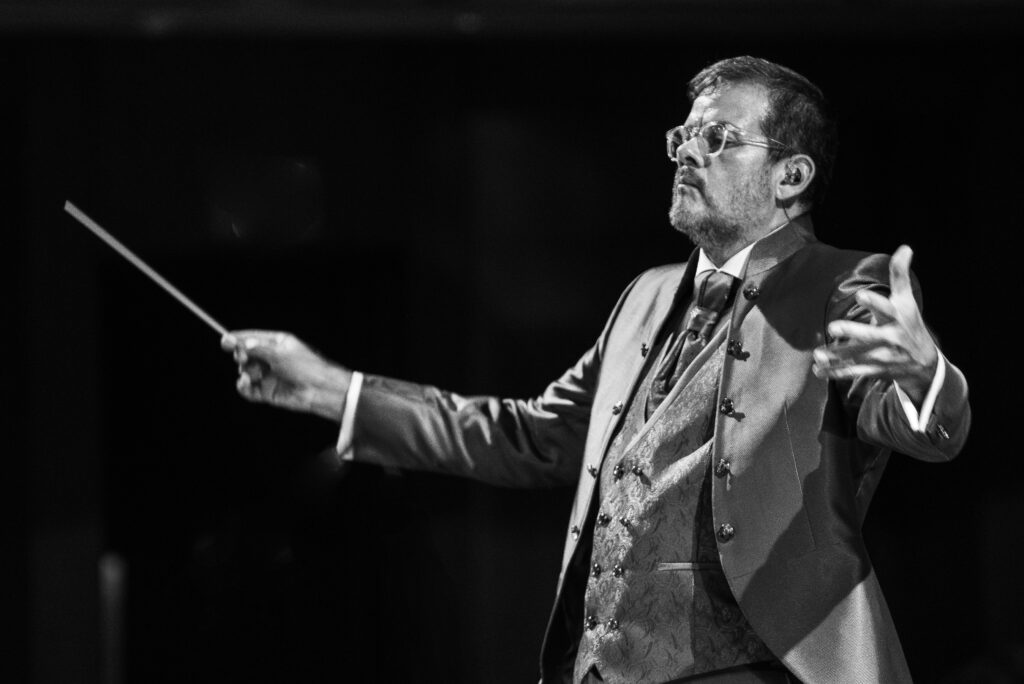
Producer, arranger, and orchestral conductor, Emanuel Olivieri has been professor at the Puerto Rico Conservatory of Music and principal violist of the Puerto Rico Symphony Orchestra.
As an instrumentalist, he has given recitals in United States, South America and Europe. He has commissioned viola works by Roberto Milano, Carlos Carrillo, Alberto Guidobaldi, Armando Ramirez, Howard Buss, Nicky Aponte, and recorded the album Music of Puerto Rico for Viola and Piano, the soundtrack for Jack Delano's film Los aguinaldos del infante, and Roberto Milano's Concerto for Viola, among other pieces.
As a conductor, he has led the following orchestras: Puerto Rico Symphony, Puerto Rico Philharmonic, National Symphony of Costa Rica, National Symphony of Panama, National Symphony of Guatemala, Queretaro Philharmonic (Mexico), Saltillo Philharmonic (Mexico), Sinaloa de las Artes Symphony (Mexico) and Boca del Rio Philharmonic (Mexico).
He produced the albums Cuatro Concertinos by Roberto Milano and Danzas para piano by Tavarez (3 volumes) with students from the Puerto Rico Conservatory of Music. As part of the latter project, he prepared a printed edition of all the surviving Tavarez danzas. His most recent recordings include works by Alberto Rodriguez, William Ortiz, Hector Campos-Parsi, and Amaury Veray.
He founded the Camerata Filarmonica Orchestra (now Camerata Pops), with which he produces a diverse series of concerts, including film music, Broadway, video games, Anime, Pop, Rock, and Children concerts. His production The Orchestra: A Musical Safari received a grant from the National Endowment for the Arts and has been presented in several countries.
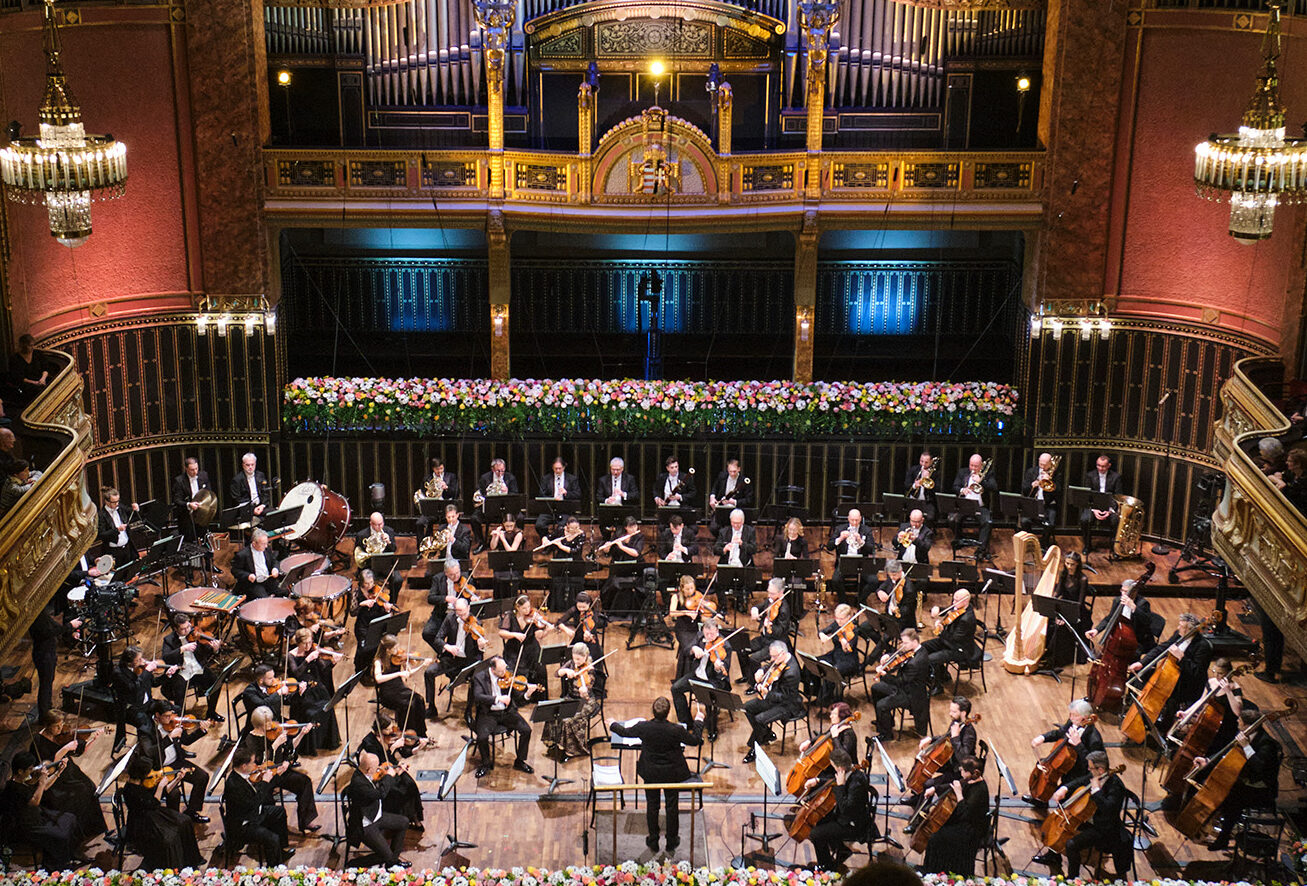
The Budapest Symphony Orchestra was founded in 1943 by composer and conductor Ernst von Dohnanyi. The Orchestra has performed internationally with the most distinguished conductors and soloists of our time, such as Janos Ferencsik, Otto Klemperer, Carlo Zecchi, Leopold Stokowski, John Barbirolli, Claudio Abbado, Charles Munch, Georg Solti, Gennady Rozhdestvensky, Neville Marriner, Bela Drahos, Johanna Beisteiner, Giuseppe Patane, Igor Markevitch, Robert Gulya and Ilaiyaraaja.
Through its frequent broadcasts and its recordings it has become widely known, and its tours have taken it to the countries of Eastern and Western Europe as well as to the United States of America and Canada. It enjoys a reputation for its interpretations of the Hungarian symphonic literature, especially works by living composers.
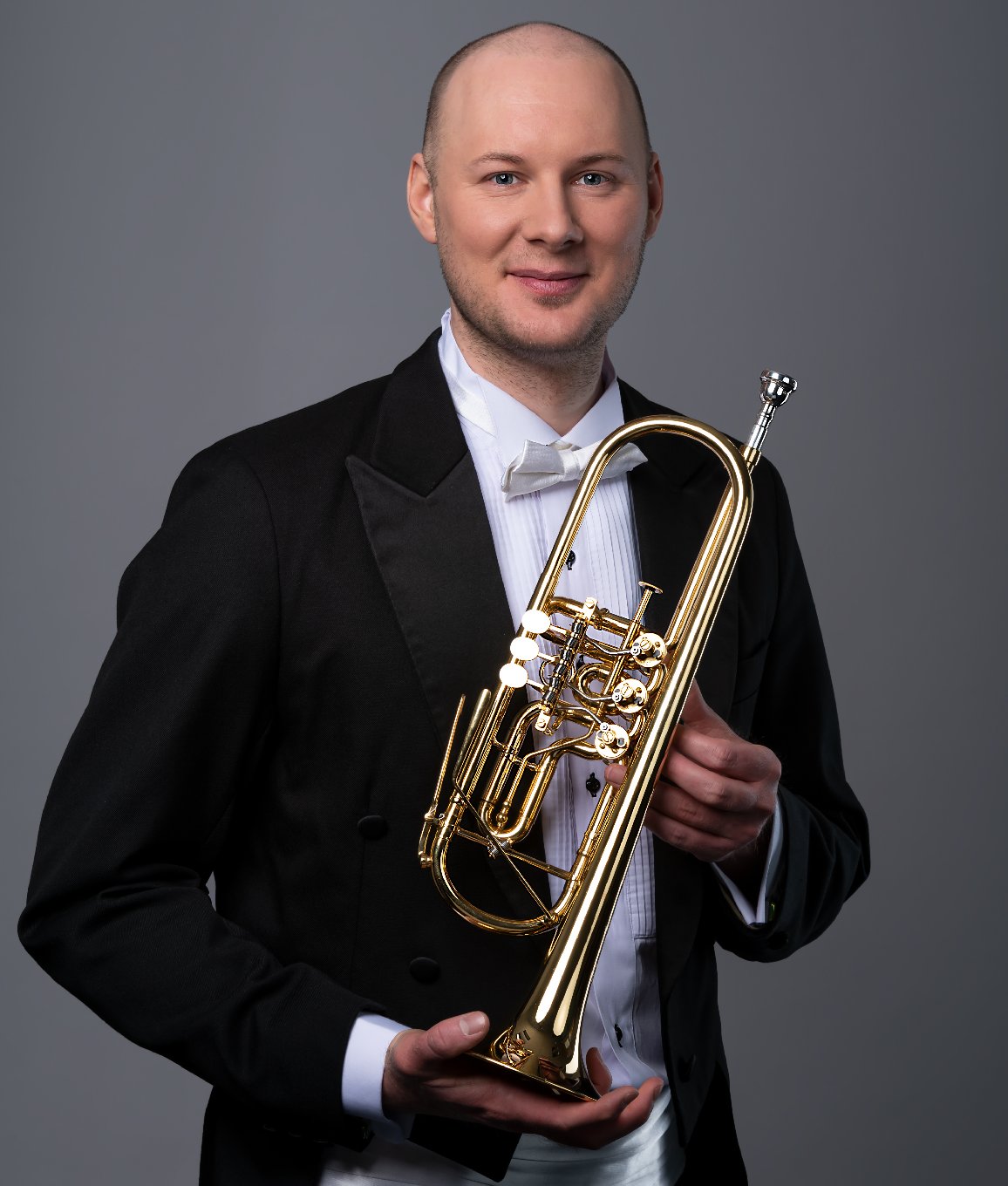
Trumpetist Balazs Pecze was born in Szekszard, Hungary, in 1988. He began learning the trumpet under the guidance of his father and later continued his studies at the Liszt Ferenc Academy of Music with Zoltan Zsucs and Janos Kirsch.
He has performed with Concerto Budapest and the Danubia Symphony Orchestra, and since 2022, he has served as the principal trumpet of the Hungarian Radio Orchestra.
For further information on Roberto Milano's music
[email protected]